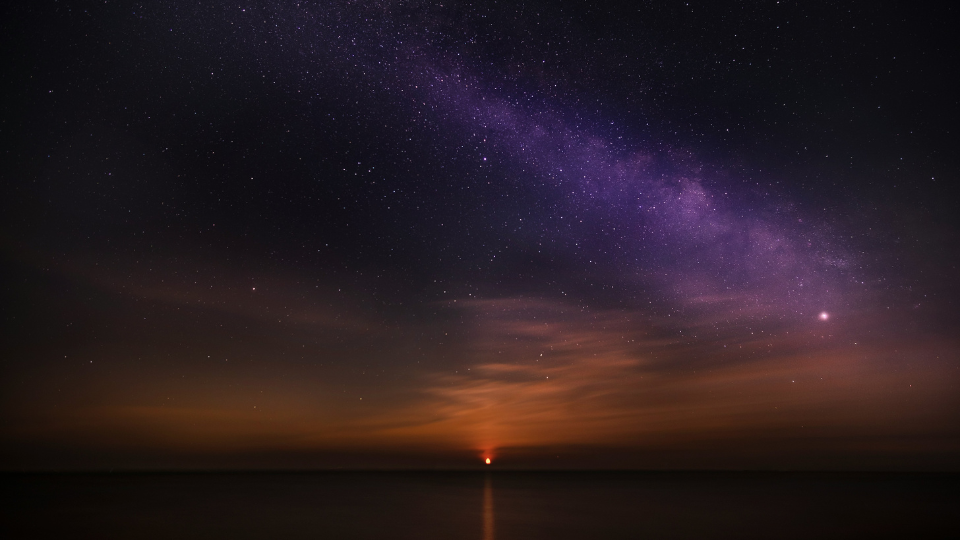
The reality we live in is built upon duality. Every force in the universe exists in contrast to another. Think of light and dark, day and night, yin and yang, positive and negative, ups and downs, feminine and masculine.
We, too, are expressions of this universal dance. Within us live two energies: the light that strives toward awareness and growth, and the dark that hides in the shadows of our subconscious.
Seeking consciousness, enlightenment, and happiness requires understanding both forces within you. The challenge is not to choose one side and reject the other, but to learn how to live consciously and harmoniously with both.
That is why I’m writing this post, so you can understand the nature of reality, the works of duality, and learn how to live in balance with two opposite forces that define who you are.
What Is Duality
Duality is the interplay of opposing, yet complementary forces that shape all reality.
Many traditions teach that to experience life, consciousness divides itself into opposites. Light and shadow, spirit and matter, heaven and earth. It is the stage where growth happens.
Science reflects duality everywhere:
- Day and night
- Feminine and masculine energies
- Positive and negative charges
- 0 and 1 in computing
- Matter and energy
Even light behaves as both a particle and a wave. Reality itself is dual in nature.
Psychologically, duality appears as conflicting impulses, desires, and emotions. We can feel love and fear, confidence and insecurity, generosity and selfishness, depression and excitement. It also mirrors the conscious and subconscious mind, the rational self, and the instinctual self.
It may seem difficult to understand that both forces co-exist within you, but that is just how it is. Duality exists, and it fuels growth. It is not something to escape, but rather something to understand.
Let’s dive deeper into both forces within us: the light and the dark.
The Light Within You
Your light is the part of you that is visible, socially accepted, and often consciously cultivated.
It includes:
- Virtues like compassion, kindness, honesty, courage, and empathy
- Higher emotions such as love, gratitude, joy, inspiration, and hope
- Your conscious behavior and intentional choices
- The aspects of the ego that help you function, create, and express yourself in the world
The light is where we feel aligned with our values and purpose. It’s where we want to be seen. It’s also where we often identify ourselves: “This is who I am.”
But light alone is not wholeness. When we cling only to the light, we unconsciously suppress parts of ourselves that don’t fit this image.
The Dark Within You
Darkness is not evil; it is unconscious.
Your darkness includes:
- Hidden behaviors and repressed emotions
- Emotional patterns formed in childhood
- Fear, jealousy, shame, anger, guilt, and resentment
- Instincts and reactions that arise automatically
The parts of you that were judged, ignored, or not allowed to exist.
The dark lives mainly in the unconscious mind. It influences your decisions even when you believe you are being rational or “positive.”
What we don’t acknowledge doesn’t disappear – it expresses itself through projection, self-sabotage, emotional triggers, and repeated life patterns.
Darkness becomes dangerous only when it is denied.
Science And The Dual Mind
Modern psychology and neuroscience affirm what spiritual traditions have long suggested, that human consciousness operates through dual layers. Freud was among the first to chart this internal landscape, describing the psyche as divided into the conscious, the preconscious, and the unconscious. The conscious mind, according to Freud, is where active thinking, decision-making, and awareness reside. Beneath it lies the vast unconscious, a reservoir of desires, memories, and instincts that silently shape behavior without our awareness. The preconscious bridges the two: the threshold where deeper material can surface into awareness.
Carl Jung expanded this understanding with profound spiritual insight. He recognized that the unconscious was not merely a storehouse of repressed impulses but also a source of creativity, wisdom, and archetypal patterns. Jung introduced the concept of the shadow – the hidden counterpart of the conscious self.
Joseph Murphy later carried these insights into the realm of the mind’s creative power. Drawing from both psychology and metaphysics, he described the subconscious mind as the fertile ground where repeated thoughts and emotions take root and manifest into lived experience. According to Murphy, the conscious mind acts as the gardener, planting seeds of thought; the subconscious mind, the soil that makes them grow.
Neuroscience now validates many of these perspectives. Brain imaging reveals a dynamic interplay between different systems: the prefrontal cortex, which is the seat of decision-making, reasoning, and self-awareness, and the limbic system, which is home to emotions, memory, and instinct.
In essence, every human thought is a conversation between two realms: logic and emotion, awareness and instinct, the deliberate and the automatic. The conscious mind is the thinker, the analyst, the orchestrator of choice. The subconscious is the dreamer, the intuitive force that remembers, feels, and manifests. True intelligence arises when these two collaborate harmoniously.
Duality and Life’s Ups and Downs: Why They Will Always Exist
One of the most misunderstood aspects of duality is the belief that balance means the end of contrast. In reality, balance does not eliminate life’s ups and downs, but it teaches you how to move through them with awareness.
Joy and sadness, expansion and contraction, success and challenge are not signs that something is wrong. They are natural expressions of a dual universe. Just as day inevitably gives way to night, moments of clarity are followed by moments of uncertainty. Growth itself happens through oscillation.
Modern culture often promotes the idea of constant happiness or permanent “high frequency” states. But this expectation creates suffering. When we resist the downward phases of life, we add judgment to experience. The result is not transcendence, but frustration.
From a psychological and neurological perspective, emotional cycles are inherent to the human nervous system. The brain and body require periods of activation and rest, motivation and withdrawal. From a spiritual perspective, contrast is what sharpens awareness. You recognize peace because you have known chaos. You value stability because you have experienced change.
Living consciously does not mean avoiding difficult emotions or challenging seasons. It means understanding that they are temporary, meaningful, and necessary. Each low carries information. Each high brings energy. Both serve evolution.
When you accept that life will always move between poles, you stop fighting reality. You become resilient rather than reactive. Instead of asking, “How do I stay up?”, you begin asking, “How do I remain centered?”
That is the true balance within duality. That is the true enlightenment many of us seek. The ability to surf life’s ups and downs, finding the middle path. But how to achieve it? I talk about it next: Self-knowledge and increased awareness.
Finding The Middle Path Through Self-Knowledge
The way to bring harmony in duality is by finding the middle path, the sweet spot between the light and the dark within us. Self-knowledge begins with the courage to look inward, not to glorify your light or condemn your darkness, but to understand both as essential aspects of your being. True awareness comes when you stop labeling parts of yourself as good or bad and start seeing them as pieces of a larger, living whole. You cannot become complete by rejecting half of who you are. Growth happens when you befriend your contradictions and learn from both your virtues and your flaws.
Life will always oscillate, and the gift of self-knowledge is that it grants you stability amid this rhythm. The more deeply you understand yourself, including your triggers, desires, and internal stories, the less you are dominated by unconscious forces, and the more gracefully you move through life’s polarity.
To find the Middle Path is to recognize that duality is not an obstacle, but a doorway to evolution. When you honour both the light and the dark, the rise and the fall, you stop resisting what simply is and begin to move with it. Within that flow lies not only the growth, happiness, and enlightenment we so fervently seek, but also a deep sense of peace and the calm presence of one who walks in harmony with both forces.
If you want to understand more about reality and how to live a conscious life, I recommend reading my post “Redefining Spirituality with Autonomy.”